
How High Will the Price of Paper Cups Rise?
Updated: Aug 20
It’s no secret that the economy was hit hard by the health crisis and the multiple lockdowns between 2019 and 2021. Since then, consumption has gradually picked up again, but some sectors have found this recovery more difficult to manage than others, with supply not always able to keep pace with growing demand. This is particularly true of the paper industry.
We take a closer look at the pulp market to understand where the paper crisis comes from and how it is linked to the rising price of paper cups.

What is driving the surge in paper prices?
Since the end of the lockdowns, consumption has resumed and demand has risen sharply in certain sectors. Paper is one of them. This increase in demand, combined with higher raw material costs, has led to a sharp rise in the price of pulp. Between October 2019 and October 2022, the price of paper more than doubled (+103%).
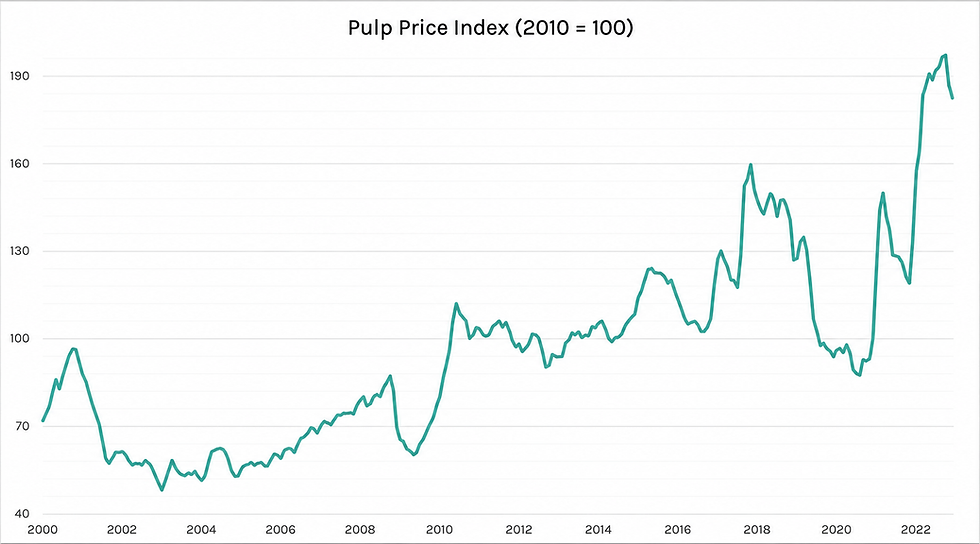
Source : INSEE
So why is paper demand no longer being managed in the same way as before the health crisis? Why is demand higher? And what explains the rise in raw material prices?
Paperboard is booming thanks to the Anti-Waste Law
Since January 1, 2020, the Anti-Waste Law for a Circular Economy has banned the use of disposable plastic cups in companies, leading many businesses to replace them with paper cups. This has resulted in a rise in demand for paper cups that the industry is struggling to keep up with.
Growing environmental awareness
Over the years, people in France have become increasingly concerned about environmental issues and, since the introduction of the Anti-Waste Law, there has been a renewed interest in environmental protection. Every person who takes steps to reduce plastic waste contributes to the growing demand for paper and cardboard packaging.
Before and after Covid-19
Since the pandemic, takeaway food and home meal delivery have grown dramatically, becoming established consumer habits. Restaurants have often had little choice but to serve their food in disposable containers, many of which are made from paper and cardboard.
Energy: at what cost?
The paper industry uses large amounts of energy to run its machinery, particularly to dry paper pulp. A paper mill spends between 10% and 20% of its production costs on electricity and gas, while the average across all sectors in the European Union is only between 1% and 3%. According to Paul-Antoine Lacour, Director General of the French Federation of Paper, Cardboard and Cellulose Industries (Copacel), “energy represents 30% of the product”, which partly explains why paper prices tend to follow changes in gas and electricity prices.
But why has the price of electricity risen so much in recent years?
First, because of the very strong global economic recovery following the Covid-19 pandemic. Energy demand surged while stocks were limited following an especially long and cold winter in Europe in 2020–2021. In France, the regulated electricity tariff rose by more than 2% in 2021 and by 4% in February 2022. The increase was nevertheless limited by the tariff shield introduced in 2022 and extended in 2023. Without government intervention, electricity bills would have risen much more sharply.
Electricity prices are also influenced by gas prices. Why? Because the price of electricity depends partly on the type of fuel used to generate it. When demand exceeds the amount of electricity produced from renewable sources — such as wind, solar and hydropower — or from nuclear power plants, thermal power stations using gas or coal are brought into operation. Gas and coal are more expensive than nuclear power, wind or solar energy, which can therefore push electricity prices higher.
In addition, since Russia reduced its gas exports to Europe following the outbreak of the war in Ukraine, electricity generated from natural gas has also become more expensive.
Congested ports
Pulp is mainly transported by sea. However, the smaller share of freight transported overland between Asia and Europe has been disrupted since the beginning of the war between Ukraine and Russia and has also shifted towards maritime routes. This has resulted in port congestion and higher container prices, both of which have had a clear impact on the cost of paper production.
And when the price of pulp rises, the price of paper-based products inevitably follows. One of the products directly affected is the paper cup, widely used by companies during their employees’ coffee breaks.
Why are paper cups affected by rising paper prices?
Manufacturers are inevitably affected by the increase in pulp production costs and often have no choice but to pass these costs on to their customers. These price increases therefore affect distributors and ultimately consumers. This is how “overall, companies manage to maintain their margins,” according to Paul-Antoine Lacour, Director General of the French Confederation of Paper, Cardboard and Cellulose Industries (Copacel).
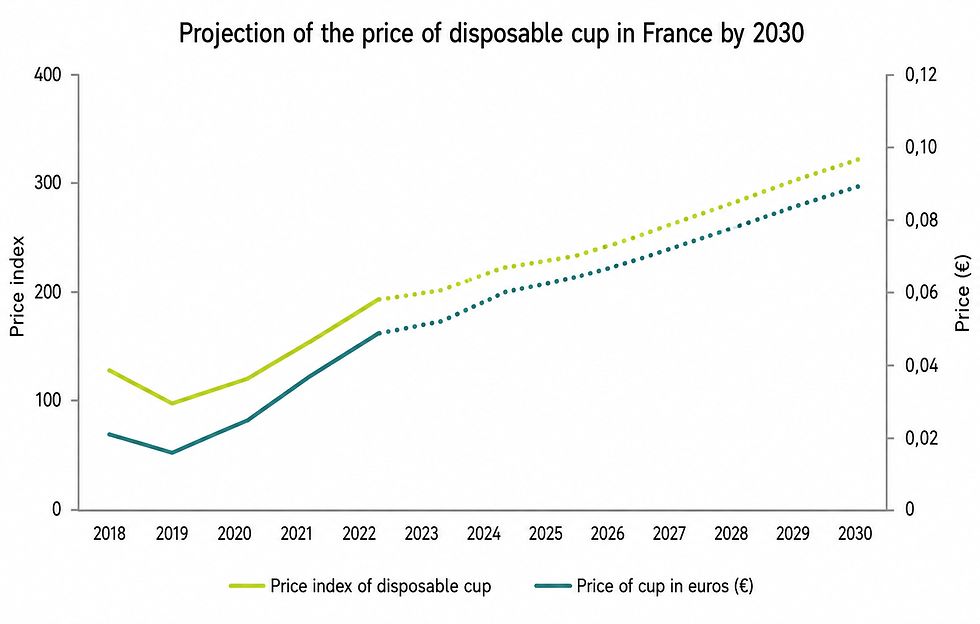
Source : INSEE
Companies that regularly use paper cups have certainly noticed the increase. In fact, the price of paper cups rose by 60% between mid-2021 and early 2022, and prices were expected to continue rising sharply over the following years. This raises an important question: are there less expensive and even more environmentally responsible alternatives?
What about other sectors?
Paper cups are becoming increasingly expensive, but what about other paper-based products? Price increases for many everyday products are also affecting household budgets.
Newspaper prices are rising
Since January 1, 2023, the retail price of newspapers sold at newsstands has also increased. The main newspapers recorded price rises of between €0.10 and €0.20.
Hygiene products are soaring
Essential hygiene products have not escaped the increase either. According to NielsenIQ, the retail price of paper towels rose by 26% between December 2021 and December 2022. Prices also increased by 20% for toilet paper, 7.6% for feminine hygiene products and nappies, and 13% for tissues and paper packaging.
Recycled paper is worth its weight in gold
A tonne of sorted paper and cardboard sold for around €160 to €180 in 2022, compared with just €20 in 2020. Perhaps sorting more of our waste could also help generate savings.
What are the alternatives to paper cups?
In addition to becoming more expensive, paper cups are not as environmentally friendly as they may appear. Their production uses 13 times more water and twice as much electricity as plastic cups. They are also extremely difficult to recycle because of the thin plastic coating used to make them waterproof.
As a result, more and more companies are adopting environmentally responsible alternatives to disposable cups as part of a zero-waste policy and a wider commitment to environmental protection. These solutions can also be financially cost-effective over the long term — two good reasons to consider them.
Reusable containers
Among these more environmentally friendly alternatives are several types of reusable containers, including reusable plastic cups, also known as ecocups, glass cups and mugs, which have the advantage of being reusable over and over again.
However, they require a certain amount of organisation and infrastructure for cleaning, such as sinks, sponges, soap or dishwashers. In practice, they are often either cleaned poorly or not often enough, or washed using far too much water, which can undermine their environmental benefits.
Auum-S: the environmentally friendly and cost-effective professional glass washer
Auum’s promise is that reusable does not have to cost more than disposable. A machine that can wash, disinfect and dry your glass in just 20 seconds, using 10 centilitres of water and no chemicals? It’s possible. Say goodbye to single-use products!
The auum-S machine provides simple, fast and effective cleaning for the auum by Bodum glass, helping to improve employees’ quality of life at work. Dry steam heated to more than 140°C cleans and disinfects the inside of the glass. In just a few seconds, auum-S kills and removes up to 99.999% of microorganisms, including viruses, germs, bacteria, fungi, spores and yeasts.
Thanks to its double-wall design, the glass is suitable for both hot and cold drinks. Reusable again and again, it can even be customised with a company logo, giving it a more personal and attractive appearance.


